
Adam and Eve, continued

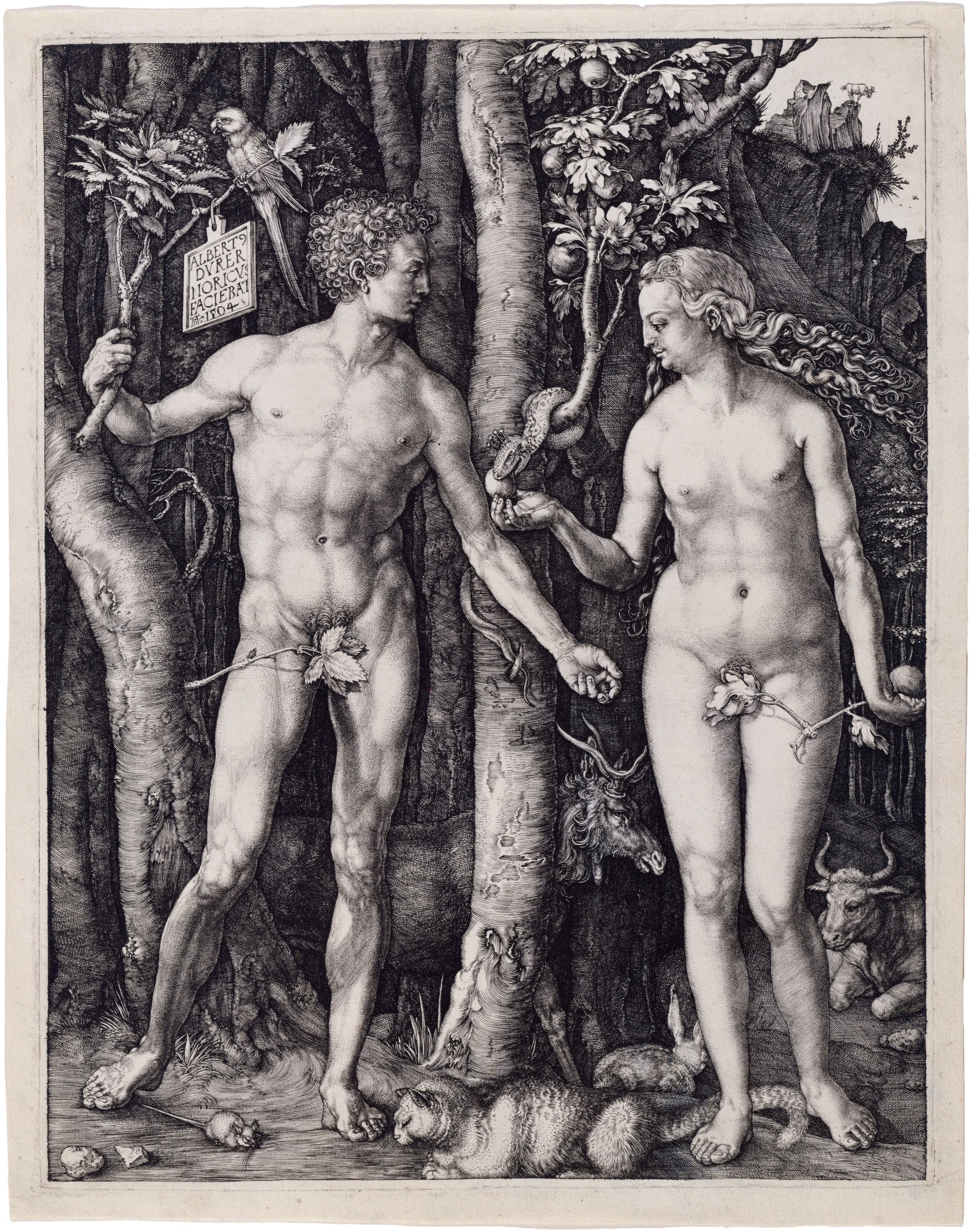
Dürer’s representation of Adam and Eve shows us that he is a student of antiquity. In fact, Dürer actually authored four books on proportion, indicating that he was deeply fascinated by the human body. Dürer presents Adam and Eve in contrapposto, reinforcing the harmony that would’ve been found in the Garden. The full-frontal pose reveals that they have not yet experienced shame over their nakedness, yet the engraving foretells what’s to come by the placement of the branches. Oddly enough, the more time I spent looking at the branches, the more I started to think that there might be some commentary on technology built into this image.
As stated in my previous post, Adam can be seen clinging to the Tree of Life. The branch that covers his genitalia is attached to the tree. While I initially thought that Dürer was making a tasteful decision, I think it needs to be understood in relation to the branch that is covering Eve. While it wasn’t immediately apparent to me, you can see that Eve is in fact holding a broken branch. The leaves that are covering her are attached to a branch that she removed from the Tree of the Knowledge of Good and Evil. Why is this significant? Because it shows Eve (and Adam) on the cusp of manipulating nature.
The leaves that cover Adam (or for that matter, Eve) do not seem to suggest shame, yet. It almost feels as though the branch works with Adam; it complements the movement of his body, allowing our eye to gracefully enter into the composition. By contrast, the leaves that cover Eve feel a bit more stulted, which I attribute in large part to the crook in the branch. I don’t want to project onto this print something that isn’t there, because I don’t believe the leaves are yet being used “because they knew that they were naked,” as stated in Genesis 3:7. Yet, it also seems that their genitalia are covered because the harmony of the Garden is about to slip away.
Given that they are naked, Dürer is showing us that they are not yet ashamed. It was only after they ate the fruit that “they sewed fig leaves together and made themselves aprons.” I have no idea how they learned to sew, or how they got the idea to make clothing, but that’s beside the point. Genesis 3:7 seems to suggest that they were using nature in a manner that it was not intended to be used.
In his book Modern Technology and the Human Future, Craig Gay writes:
Our knowledge of ourselves is never direct. It is reflected back to us in the relations that we have with “others,” which includes our lived environment. If these relations are stunted and/or distorted, they will reflect back an image of ourselves that is also stunted and/or distorted (120).

Craig Gay is drawing heavily upon Heidegger’s essay The Question Concerning Technology, and his idea of “standing-reserve.” To quote Gay, standing-reserve is when things “no longer stand over and against us as things with their own integrity, apart from our use of them” (119). To use the leaves as a means of covering yourself is not to properly cooperate with nature as God originally intended. Instead, it’s to use and view nature as a resource that is available for me whenever I need it. The reality is that we all use nature this way, so it might not seem like a big deal. However, using nature in this way “inhibits us from truly listening to given nature and thereby prevents us from experiencing the existential change that might have come through our appreciation of its otherness” (122). This is significant to state, as it explains why we can oftentimes feel so disconnected (Genesis 3:10) from each other and the world. We no longer have the capacity to work with our environment, and more often than not struggle alongside it. The fact that the branch is broken is no small thing.
In John 20, Mary Magdalene is the first person to see Jesus after his resurrection. Mary is at the tomb of Jesus weeping, thinking that his body has been taken away. Suddenly Jesus stands before her, and asks her why she is weeping; however, she doesn’t recognize him. What’s fascinating about this passage is the significance of one little detail John chooses to include in verse 15. John writes, “Supposing him to be the gardener…” I’ve read the Gospel of John numerous times throughout my life, but it only occurred to me recently why Mary wouldn’t have recognized Jesus - it has everything to do with the state of the original Garden. The Gospel of John is intentionally playing on the creation narrative. Mary confusing Jesus for a gardener is meant to draw our attention back to Adam, who was also a gardener. Mary was looking at a man fully alive, finally living in harmony with his environment, but she did not yet have eyes to see. Dürer’s Adam and Eve allows us to glimpse the reality of the world before the Fall, even if it’s only for a moment.